
Korean contractors participating in U.S. projects involving LG, Samsung, SK, and other major Korean corporations are increasingly seeking assistance with workers’ compensation certificates. This is particularly common for projects in Ohio, where project owners or general contractors may require contractors to register with the Ohio Bureau of Workers’ Compensation, or BWC, and submit a Certificate of Coverage.
Common inquiries include:
“We were instructed to register with Ohio BWC and submit proof of coverage to LG.
Our U.S. insurance provider told us that a foreign company cannot register with BWC.
How should we proceed?”
Even after a company has secured a contract for a U.S. project, it may be unable to mobilize personnel if the required workers’ compensation documentation is not submitted by the deadline. Site access, safety training, work authorization, employee badges, and equipment entry are often approved only after the insurance, safety, and compliance documents required by the project owner and site manager have been completed.
A workers’ compensation certificate should therefore not be treated as a document that can be prepared gradually after the contract is signed. It is a pre-mobilization requirement that should be reviewed together with the project schedule.
This is particularly important in Ohio, where workers’ compensation is generally administered through the state BWC system rather than through the private insurance structure used in many other states. Korean companies may therefore need a separate practical review from the outset.
Why Prime Contractors Require Proof of Workers’ Compensation Coverage
Workers’ compensation coverage is an important compliance item at U.S. project sites. If a contractor does not maintain valid coverage and one of its workers is injured, the resulting claim and legal exposure may affect the project owner, general contractor, or site manager.
For this reason, major project owners, EPC contractors, general contractors, and site-management companies frequently require each contractor to provide evidence of workers’ compensation coverage before work begins. The document may be connected to site registration, safety orientation, work permits, badge issuance, and other mobilization procedures.
Contractors should pay particular attention to the submission deadline. A delay in providing the required certificate may affect not only the deployment of personnel but also equipment delivery, installation, commissioning, and subsequent phases of the project.
Because multiple contractors often work under an interdependent schedule, a delay in one company’s compliance documentation can create broader project-management issues.
A workers’ compensation certificate is often a condition of site access, not merely an administrative insurance document.
How an Ohio BWC Certificate Differs from a Standard Insurance Certificate
One of the most common sources of confusion arises when a U.S. insurer or local broker tells a Korean contractor that a foreign company cannot register with Ohio BWC.
This response should be considered in light of Ohio’s workers’ compensation structure. Ohio generally requires private employers to obtain statutory workers’ compensation coverage through the state insurance fund administered by BWC unless the employer has been approved to self-insure. A conventional workers’ compensation policy issued by a private insurer may therefore not satisfy the requirement for Ohio coverage.
As a result, the proof of coverage required for an Ohio project may not be available simply by requesting another commercial insurance certificate from a private carrier. The employer may need to complete the applicable BWC registration, work-classification, payroll, and premium procedures.
When an insurance provider states that a foreign company cannot register, the practical issue may be that the provider does not handle BWC registrations for foreign entities. That response does not necessarily establish that every foreign corporation is categorically ineligible.
Ohio law expressly addresses nonresident persons, firms, and corporations that conduct activities in Ohio in a manner that makes them employers under the state’s workers’ compensation laws.
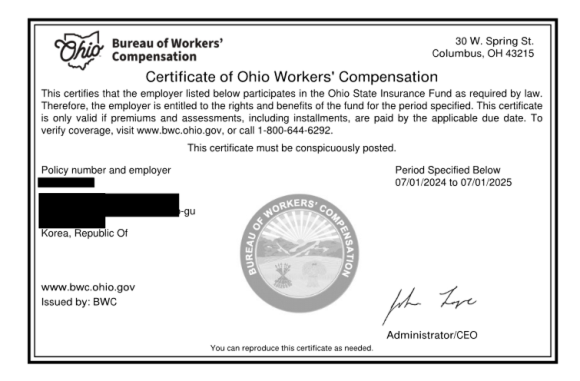
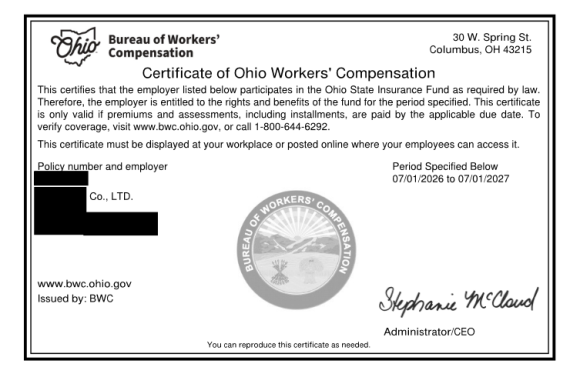
Hanbridge Partners has assisted Korean corporations without a separately incorporated U.S. subsidiary in obtaining Ohio BWC documentation under their Korean legal names and submitting it to project owners or contractors.
Practical Challenges for Korean Corporations
For a U.S. company, the BWC application process may be relatively standardized. The application can generally be organized using the company’s U.S. entity information, federal tax identification number, business address, employer details, payroll information, and work classification.
A Korean corporation often begins from a different position. It may not have a U.S. EIN or a previous employer registration with the Ohio workers’ compensation system. Its Korean headquarters address, Korean legal name, U.S. project location, employee duties, and expected period of work may not fit neatly into a system designed primarily around domestic employers.
The company may therefore need to determine how its foreign legal name and address should be entered, whether a U.S. contact is required, whether an EIN must be obtained, which work classification applies, and how the premium basis should be reported.
Ohio’s current coverage application asks for the registered legal name of the business and limits the name field to 40 characters, illustrating one of the practical formatting issues that may arise for foreign entities.
The classification review is particularly important for projects involving manufacturing equipment, batteries, semiconductors, electrical work, piping, industrial automation, cleanrooms, installation, or commissioning. The applicable classification may depend on the work actually performed at the site rather than solely on the company’s general business description.
The review may also differ depending on how long the employees will work in Ohio and whether they were hired specifically to work there. Ohio rules state that employees hired specifically to work in Ohio must generally be reported under the Ohio fund. The rules also contain limited provisions concerning out-of-state employees who are temporarily working in Ohio and already covered under another state’s workers’ compensation laws.
These rules should not be applied mechanically to Korean employees, because coverage under Korean law is not necessarily treated in the same manner as coverage under another U.S. state’s workers’ compensation system.
The company’s legal identity, workforce structure, project duration, and actual on-site duties should be reviewed together.
Practical Issues to Confirm before Applying
Obtaining an Ohio BWC Certificate is not the same as purchasing a standard commercial insurance policy. The Korean corporation’s information, Ohio project details, employee duties, and submission requirements should be organized before the registration begins.
The company should first determine whether the requested document is a general insurance certificate or an Ohio BWC Certificate of Coverage. Documents described as a Workers’ Compensation Certificate, Ohio BWC Certificate, or Certificate of Coverage may not be replaceable with a Commercial General Liability policy or another general liability certificate.
The company should also avoid beginning the process immediately before mobilization. Additional time may be required where the application must be made in the name of the Korean headquarters or where the company does not have a separately incorporated U.S. entity.
General accounting, tax, and insurance providers do not always handle this process. An accountant may assist only with an EIN or tax registration, while an insurance broker may work only with private insurance products. Ohio BWC registration may be treated as a separate compliance matter.
This can leave a Korean contractor in a difficult position: the project owner requires the document, the insurer states that it cannot provide it, and the company is unsure which authority or procedure applies.
In such cases, support from an adviser familiar with both the Ohio system and foreign-company project structures may be necessary.
Ongoing Obligations after the Certificate Is Issued
The issuance of a Certificate of Coverage may not be the final step. Depending on the account and project structure, the employer may also need to manage payroll reporting, premium payments, account updates, and later reconciliation.
Ohio’s premium rules require employers to report applicable remuneration and remit amounts due following payroll and premium reconciliation.
The company should therefore confirm which employee earnings are reportable, how long the account should remain active, and whether updates are required if the project period, workforce, or scope of work changes.
If additional personnel will travel to Ohio for later phases of the project, maintaining the account may be more practical than closing it immediately after the first assignment. Where the project is completed and no further Ohio work is expected, the company should review the appropriate account-closing procedure rather than simply discontinuing reporting.
How Hanbridge Partners Can Help
Hanbridge Partners assists Korean companies with obtaining state-specific workers’ compensation documentation required for participation in U.S. projects.
Our work includes reviewing Ohio BWC requirements and the submission conditions imposed by project owners, general contractors, and site managers. We organize the process according to the Korean company’s legal structure, workforce arrangement, on-site work, and project schedule.
Early review is particularly important for Korean headquarters without a separately incorporated U.S. subsidiary, Korean Co., Ltd. entities, projects involving short-term employee assignments, and cases with an imminent submission deadline.
Using an application structure that does not reflect the company’s foreign status or actual work may lead to registration delays, classification questions, or delays in issuing the Certificate of Coverage.
Hanbridge Partners assists with organizing the principal BWC registration information and obtaining the Certificate of Coverage in the format required by the project owner or contractor. We also review ongoing reporting and account-maintenance requirements after the project begins.
Where projects involve other jurisdictions, we may also assist with workplace insurance registrations such as Ontario WSIB in Canada.
Korean contractors participating in U.S. projects involving LG, Samsung, and SK have used these procedures to submit their workers’ compensation documentation and proceed with site mobilization. The process is coordinated in Korean and English to reduce communication difficulties between Korean headquarters and U.S. project personnel.
Key Takeaways
For Korean contractors participating in U.S. projects, proof of workers’ compensation coverage is often directly connected to site-mobilization approval.
Even where the contract has been signed and the project award is confirmed, personnel deployment, work commencement, and equipment entry may be delayed if the required certificate has not been issued.
In Ohio, requesting a standard policy from a private insurer may not satisfy the project requirement because statutory workers’ compensation coverage is generally administered through the state BWC system. A Korean corporation may still need to evaluate Ohio registration even if it does not have a separately incorporated U.S. subsidiary.
Korean contractors asked to submit insurance documentation for an LG, Samsung, SK, or other U.S. project should first confirm the exact type of certificate and the submission deadline. Where an Ohio BWC Certificate is required, the company should review the proposed employer name, employee structure, project scope, work classification, and reporting obligations at an early stage.
The practical objective is not simply to obtain an insurance document, but to secure the coverage evidence required for timely site mobilization.