
Korean companies participating in projects at the invitation of a Canadian customer or prime contractor are often required to submit a Certificate of Insurance, or COI, before beginning work. A COI confirms that the company has the required insurance coverage and is frequently included among the site-access requirements for equipment installation, inspection, commissioning, technical support, and maintenance work in Canada.
The questions most frequently raised by Korean companies are generally similar:
“Our Canadian customer has requested a COI.
Can a Korean company obtain insurance coverage in Canada?
What coverage limit should we expect, and how much will the premium be?”
Hanbridge Partners has assisted multiple Korean suppliers participating in Canadian projects involving LG and NextEnergy with CGL coverage and COI issuance. Based on the issues repeatedly encountered by LG suppliers in particular, this article outlines the key matters Korean companies should review before beginning a Canadian project..
What Are a COI and CGL Insurance?
A COI is not the insurance policy itself. It is a certificate confirming that the insured company maintains the coverage required by the customer or prime contractor. Canadian customers frequently request a COI before work begins to confirm that a contractor has insurance protection against potential accidents, injuries, and property damage at the project site.
CGL stands for Commercial General Liability. Korean companies sometimes refer to it simply as property damage insurance, but that description is too narrow. CGL insurance generally provides broader protection against certain liabilities arising from business operations, including bodily injury and property damage claims made by third parties.
When a Canadian customer requests a COI, the process should therefore not be treated as a simple request for a one-page certificate. The company should first confirm the required type of insurance, coverage limit, project name, site address, work period, and any additional insured wording required by the customer.
The COI is evidence of coverage, while the CGL policy determines the actual scope and limits of that coverage.
Canadian Insurance Coverage for Korean Companies
A Korean company may be able to obtain Canadian insurance coverage if it satisfies the applicable underwriting requirements. One of the key preliminary items is often a Canadian Business Number, or BN, issued by the Canada Revenue Agency. A BN functions as a Canadian business identifier, and a Korean company may be able to register with the CRA as a foreign business without first establishing a Canadian subsidiary.
Hanbridge Partners has supported BN registrations for companies facing urgent project schedules. In several LG supplier matters handled last year, the BN was issued on the same day. However, the appropriate registration process and the availability of expedited handling may vary depending on the company’s structure, the nature of the project, and the scope of its Canadian activities.
Canadian insurers generally assess the legal identity of the proposed insured, its connection to the Canadian project, the nature of the work to be performed, and the requested coverage limit. In some cases, the Korean corporation may be insured directly. However, not every project or insurer follows the same structure, and the available arrangement depends on the underwriting review.
A Korean company may be eligible for Canadian CGL coverage without incorporating a Canadian entity, but the structure must be confirmed in advance.
Tax Considerations Related to Canadian Project Work
Where a Korean company performs work in Canada, tax matters may arise separately from the insurance process. If the company receives compensation for services performed in Canada, it may need to consider Canadian corporate income tax, withholding requirements, and the availability of treaty-based relief or other exemptions.
Many Korean companies have already paid, or expect to pay, Korean corporate income tax on the same business income. If Canada also imposes tax on that income, a double-taxation issue may arise. The company should therefore review the applicable Canadian tax rules and the Canada–Korea tax treaty before the project begins.
CRA applications for treaty-based relief, withholding waivers, or other tax treatment may require substantial processing time. If the process begins only after employee travel dates or site-entry dates have been confirmed, the company may face significant scheduling pressure. It is generally safer to review the insurance and tax requirements as soon as the project timeline is established.
Where the insured is a Korean company that has obtained a Canadian BN but is not legally incorporated in Canada, the claims and payment structure may also require additional review. For this reason, some Korean companies consider establishing a Canadian subsidiary or branch to clarify the insurance, contractual, and liability structure for recurring Canadian operations.
Obtaining insurance does not resolve the company’s separate Canadian tax and withholding obligations.
Time Required to Issue a COI
Once the insurer has completed its underwriting review and approved the coverage, the COI itself may be issued relatively quickly. In one matter handled by Hanbridge Partners, we coordinated with the Canadian insurer on an urgent basis and obtained the certificate within approximately two days.
The more significant timing issue is usually the preparation required before the insurer can begin its review. A BN may be required, and the customer’s insurance conditions, project details, and scope of work must be organized in a form acceptable to the insurer.
The key question is therefore not simply how many days it takes to issue the COI, but whether the application materials are sufficiently complete for underwriting. If the BN, project information, work scope, required coverage limits, or customer-provided certificate format have not been finalized, delays are likely to occur before the COI issuance stage.
The fastest COI process begins with complete project and underwriting information.
CGL Premiums and Coverage Limits
CGL premiums vary depending on the requested coverage limit, the nature of the work, the level of on-site risk, the duration of the project, and the specific contractual requirements imposed by the customer.
An insurer may assess a project differently depending on whether the work involves a simple inspection, equipment installation, commissioning, electrical or mechanical work, work at height, or the use of specialized machinery at the site.
Many CGL policies also have a minimum premium. Even where the work is relatively low risk or the company will remain in Canada only briefly, a minimum premium may still apply. The cost therefore does not necessarily decrease in direct proportion to the length of the business trip.
Hanbridge Partners has assisted clients performing various types of work in Canada with CGL coverage. Many of our existing clients obtained coverage equivalent to approximately KRW 5 billion at or near the insurer’s minimum premium. The actual coverage limit and premium, however, vary depending on the customer’s requirements, the nature and risk of the work, and the insurer’s underwriting decision.
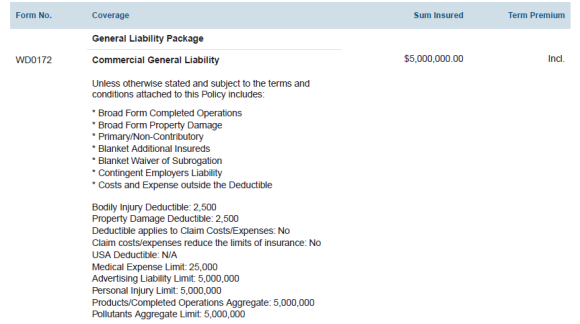
Example of CGL Coverage with a Limit of Approximately KRW 5 Billion
How Hanbridge Partners Can Help
Hanbridge Partners assists Korean companies with the COI and CGL insurance requirements associated with Canadian projects. We review the company’s eligibility for a Canadian BN, the proposed insurance structure, the customer’s coverage requirements, and related CRA tax considerations, and organize the required materials in line with the project schedule.
During the insurance application process, clients may provide their basic company and project information in Korean. Hanbridge Partners then organizes and converts the information into the English-language format required by the Canadian insurer.
This allows Korean headquarters personnel who are unfamiliar with Canadian insurance practices to explain the project and work scope in a practical manner while ensuring that the final submission meets the insurer’s underwriting requirements.
Based on our experience supporting Korean suppliers participating in projects involving LG and NextEnergy, our services may include BN registration, CGL placement, COI issuance, coverage-limit review, Canadian tax considerations, and, where appropriate, an initial review of whether a Canadian subsidiary or branch should be established
Key Takeaways
When a Canadian customer or prime contractor requests a COI, the requirement is connected to the broader insurance, tax, and compliance framework governing the company’s site activities. A Korean company may be able to obtain Canadian insurance coverage, but it should review the BN registration, CRA-related tax procedures, identity of the insured, coverage limits, and premium structure together.
Starting the process only shortly before employee departure or site mobilization may create scheduling pressure because BN registration, insurer underwriting, and COI issuance are interdependent.
Korean companies planning to participate in a Canadian project should confirm the customer’s COI requirements early and assess the availability of CGL coverage before the scheduled start of work.
The objective is not merely to obtain a certificate, but to establish an insurance structure that satisfies the customer’s requirements and reflects the company’s actual Canadian activities.